 CodeKitHub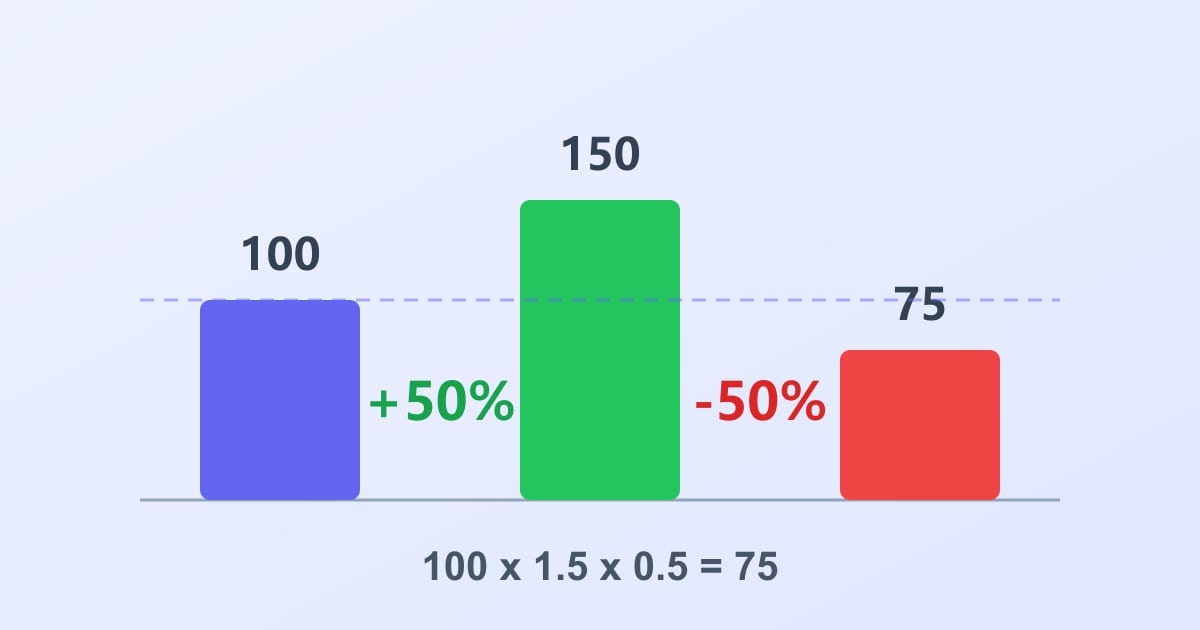
Why +50% then −50% doesn't get you back to where you started
Published Aug 14, 2026
Here’s a question that trips up almost everyone the first time: a stock you own rises 50%, then falls 50%. Are you back where you started?
It feels like yes. The answer is no — you’ve lost 25% of your money.
The math, step by step
Say you start with $100:
- +50% → $100 × 1.5 = $150
- −50% → $150 × 0.5 = $75
You end at $75, not $100. And the order doesn’t matter: fall 50% first ($100 → $50), then rise 50% ($50 → $75), and you land in exactly the same place.
Why this happens
Each percentage is calculated from a different base. The +50% is measured against your original $100, but the −50% is measured against the new, larger $150. Half of 150 is simply a bigger number than half of 100 — so the drop takes away more dollars than the rise added.
That’s the whole trick. A percentage is not an absolute amount; it’s a ratio relative to whatever the value happens to be at that moment. Change the base, and the same percentage means a different amount of money.
The recovery table
The deeper consequence: after a loss, you need a larger percentage gain to get back to even.
| Loss | Gain needed to recover |
|---|---|
| −10% | +11.1% |
| −20% | +25% |
| −33% | +50% |
| −50% | +100% |
| −75% | +300% |
| −90% | +900% |
A 50% loss needs a 100% gain — a full doubling — just to break even. This is why large investment drawdowns are so punishing, and why “it dropped 80%, it can’t fall much further” is a dangerous way to think: from there, a further 50% drop is still a further 50% drop.
Where else this bites
- Stacked discounts: “20% off, then an extra 30% off at checkout” is not 50% off — it’s 1 − (0.8 × 0.7) = 44% off.
- Salary cuts and raises: a 10% pay cut followed by a 10% raise leaves you at 99% of your original salary.
- Inflation vs. returns: 5% inflation is not “cancelled” by a 5% return, for the same base-shifting reason — compounding over years widens the gap.
Checking your own numbers
If you want to verify any of these without doing the algebra, our percentage calculator handles the three everyday percentage questions — X% of a number, what percent X is of Y, and the change between two values — with results as you type. For multi-year effects like the inflation example, the compound interest calculator shows how the same asymmetry compounds over time.
The one-sentence takeaway: percentages up and down are not symmetric, because each one is measured from a different starting point. Whenever a sequence of percentage changes is involved — sales, portfolios, pay — do the multiplication rather than adding the percentages, and the trap disappears.